Interview of the Month: Eleanor Lange on Library Management

I’ve decided that as part of my blog I will interview a librarian every month on a different topic. This month my lovely interveiwee (and my boss this summer) is Head of the Fennell Music Library at Interlochen Center for the Arts, Eleanor Lange. First, a little about Eleanor.

Eleanor began her work as the Head of the Fennell Music Library in March of 2011. She grew up in Knoxville, TN and graduated from Maryville College in 2000 with a BM in Vocal Performance. She studied voice, performed, and worked in Atlanta, GA (woohoo Georgia!) for five years before deciding to go back to school. Eleanor received her Masters in Library Science with a Music Librarianship Specialization in 2009 from Indiana University. After finishing her degree, she worked for the Jacobs School of Music at Indiana University as the Band Librarian before joining the staff at the Fennell Music Library.

The focus of my interview with Eleanor was library management. As my own library manager, Eleanor runs the music library with fairness, common sense, and an open ear to the opinions of her colleagues and employees. All this and more has led me to respect her as a manager and wonder what her secret to success is. As someone who will be managing an employee very soon, I thought it would be a good idea to pick the brain of an expert manager while I had the chance …

MG: So what made you decide to become a librarian?

EL: Well, I was a performer and performers don’t make much money and I knew I needed to make a living. I also wanted to do something I was passionate about, and I had worked in a music library in graduate school and really felt at home there.  For a while in Atlanta I talked to a science librarian about what she did and, while being a science librarian isn’t exactly like being a music librarian, I learned a lot from her and developed a sense that that’s what I wanted to do.

MG: Could you tell me a little more about your background in management specifically?

EL: Sure. I was the band library assistant at Indiana University and managed two to three student workers. Then in the Variations Program (also at Indiana University), I managed two student workers as well.

MG: What would you say are the qualities of a good manager?

EL: A good manager needs to be open-minded and needs to listen to what everyone has to say when making decisions. Good communication is key as well. Sometimes you have to be stern, which is difficult, especially if there are age differences between you and those you manage—for example, I managed someone who was much older and had been here for a long time. You need to learn how to talk with a person respectfully if something needs to be changed.

MG: Well, you mentioned some of them, but what are the biggest challenges you face as a library manager?

EL: Being young and having older people as employees. Also, you might want to be everybody’s friend, but sometimes you can’t be. Sometimes you have to do things that make you not everybody’s favorite person, but your company needs that to happen. You have to learn to say no. You always want to say “Sure!” in customer service, but you can’t always do that.

MG: What would you say is your biggest accomplishment as a manager?

EL: Hmm… I guess learning to be a manager in this situation. I’m a manager in the library and in lots of other places—I work with faculty, conductors. I have to earn their respect and work with lots of different personalities. Also, I’d say teaching the interns each year is a big accomplishment.

MG: Have you ever had a really great manager? How did that person inspire you?

EL: Well, I really look up to Sandra [the Head of Interlochen’s Academic Library and Eleanor’s coworker]. She’s taught me a lot about how to convey things as a manager. She wasn’t my manager, but she was my advisor for my sound recording cataloging internship. She taught me how to teach, how to be a mentor–she was my mentor.

MG: If you could give any other advice–management related or not–to a new librarian, what would it be?

EL: Keep your mind open. Keep it open to new technology, keep it open when working with administration or managing employees. Listen to what others have to say and keep in mind that you’re the new person. My predecessor here at the music library wasn’t well-liked by everyone so I was under lots of pressure to do a better job than he did. I learned to listen to what my colleagues had to say and be a team player. Also, make sure you don’t back down all the time–speak your mind when you have an opinion about a decision. Sandra and I always communicate, so we always know each other’s opinion about decisions and that’s really important.

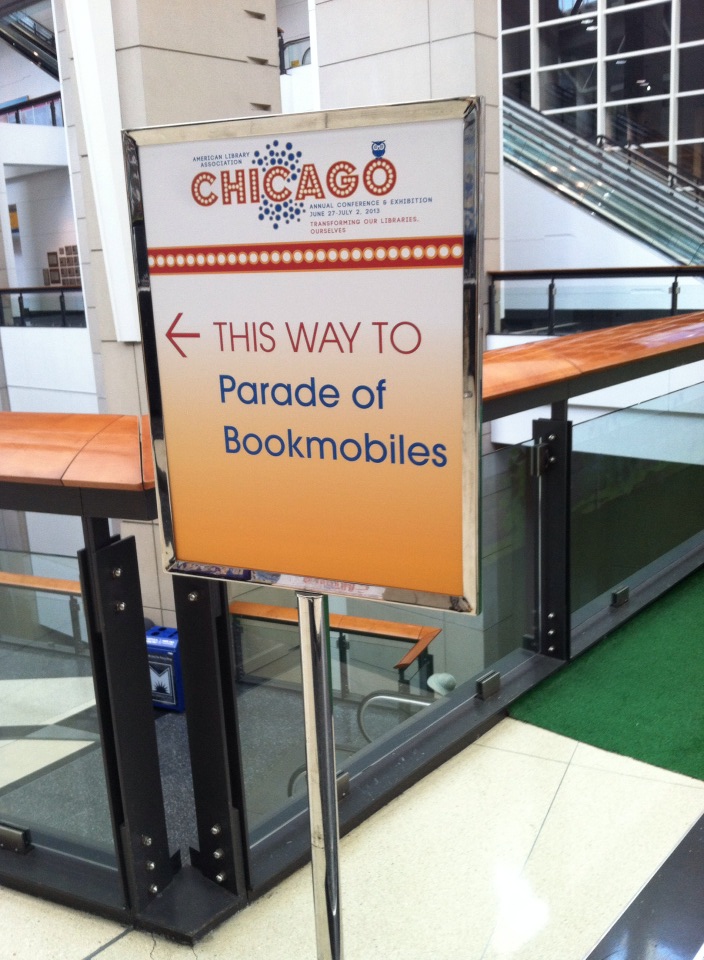
My First ALA or There’s a Parade of Bookmobiles?!?

1060499_10151736884693115_496743067_n

There were over 15,000 attendees at the ALA Conference in Chicago. Just think about that for a moment.

15,000.

That’s a crazy number of people! That also means a crazy number of sessions, programs, posters, exhibits, committees, round tables, social events … Needless to say, my first ALA was a little bit overwhelming.

That said, I had an awesome weekend at ALA. I learned so much about how to better serve library patrons, how libraries influence others, and, in general, what concerns librarians have in today’s world. Because there was so much happening at this conference, I could pretty much write a book about all the things I learned and experienced. However (you’re welcome), I’m going to refrain from doing that and instead give you a quick and dirty overview of some of my most memorable ALA experiences.

RUSA 101 – This session was a great way to meet other librarians, and because we sat according to the sections of our interests, I got to meet a bunch of other librarians interested in emerging technology and reference. Surprise, surprise, I am now on a list to help out with outreach for that section (MARS). Plus–bonus!–I won the book Canada by Richard Ford.

ACRL 101 – Yeah, another 101 session. Those things were everywhere! Actually, seeing as this was my first ALA conference, introductory info like the stuff presented at this ACRL program was just what I need. I was able to get a sense of ACRL’s values, their future programs (woo-hoo Portland 2014!), and ways I could get involved. Thanks to the program I met representatives from both the University Libraries and Instruction Sections, both of whom I already have contacted about getting involved further. Yay over-commitment!

Exhibit Hall – I think this place will be what heaven is like for librarians. I literally filled two (free) bags with free books. And one of the bags had a cat on it. ‘Nuf said.

Virtual Reference Discussion Forum – This was my first conference discussion forum, and it was really interesting to hear what challenges and successes librarians from all over the country and from all kinds of libraries are experiencing. It turns out that we’re all frustrated by a lot of the same things. It also turns out that librarians are smart, so talking through things as a group helped everyone find new solutions.

Bringing the Immersion Program Back Home – This session really made me want to participate in the Immersion program! It sounds like just the kind of uncomfortable, stressful, life-changing week I need. And all of the presenters seemed like fantastic teachers and librarians! Coincidence? I think not.

Building Your Professional Toolkit – Parts of this session were really relevant to me, and other parts (now that I’m employed) really weren’t. My two favorite speakers talked about emotional intelligence and effective management using the 4 F’s. Look up both concepts–it was really fascinating!

Lessons for the Librarian: 10 Tips for Teaching the One-Shot Instruction Session – This, I think, was my favorite session. Not only was the content fantastic and relevant, but the delivery was extremely entertaining. The session started when one of the speakers started singing “Moon River” into the microphone. And it only got more hilarious from there. Besides being really engaging, the speakers shared some great insights into improving one-shot sessions, such as the importance of enthusiasm, the idea that collaboration with faculty is key, and how helpful planning ahead can be.

Massive Open Online Courses (MOOCs): The Future of Learning? – Besides providing a thorough background of MOOCs, this session shared some of the controversial and difficult aspects of MOOCs and how librarians fit in. It was one of the most fascinating sessions I attended and one that I have already talked about at length with librarians back at home.

Alice Walker – This woman just RADIATES wisdom and peace, even as she talks about how horrible and violent the world is. Even though I’m not personally unfairly imprisoning people or causing children to starve, she made me feel a perfect mixture of crushing guilt and the inspiration to make the world a better place.

Worth every penny (and a terrifying ride on the L), my ALA experience was just what I hoped it would be: a chance to learn, make connections, and get lots of swag! Look out for me at ALA 2014 in Las Vegas!

What I Learned in Library School — Outside the Classroom

It’s been over a month since my graduation ceremony, and while I haven’t received my official Masters of Science diploma yet, I still feel that I’ve had enough distance from my library science education to reflect a little on its value for me as a new professional.

To give you some background, I graduated from the Library and Information Science program at the University of Illinois at Urbana-Champaign last May, and it took me two years to finish. My focus was on reference and instruction in the humanities (especially music), but I experimented quite a bit in my time as a student. In fact, many of my most valuable experiences as a library student didn’t occur in the classroom at all, which is why I thought it would be useful to share some things I learned outside of the curriculum of my classes. I realize that my experience was unique to my own choices and interests, but I hope that I have a few morsels of advice that could be useful for other recent graduates, those currently in a library science program, or those considering applying for a library science program. And comments from any others who have words of wisdom to share are very much welcome!

Get involved. This can be as simple as becoming a member of one of your school’s professional association student chapters or volunteering to help with the annual book sale. And it could be as ambitious as organizing a larger event at the school or representing your program by presenting at a conference. Being involved has so many benefits. To name a few: it helps you network and meet others with similar interests, it allows you to share your ideas and have an impact on your program, it (therefore) improves your program, it prepares you for professional work (being on committees, brainstorming programming, etc.), and it gets your name out there so that when an opportunity arises, people think of you.

Create Opportunities. Your perfect internship or practicum experience may not exist, but that doesn’t mean that you can’t take the initiative to create a niche for yourself. This could involve the creation of a new internship or volunteer opportunity, or it could just mean that you start a new program or project within an opportunity with which you are already involved. I really wanted some experience teaching, but I wasn’t able to get a graduate assistantship that focused on library instruction. Instead of just giving up, I created some workshops at the library where I worked, the Music and Performing Arts Library, that allowed me to implement learning outcomes, a lesson plan, and assessment techniques. Those workshops later provided me with valuable experience to put on my resume.

Make connections. This doesn’t just mean formal networking! There are lots of connections you can make in an informal way–after all, you are surrounded by hard-working, creative library science students every time you enter your library science building. I cannot tell you how many wonderful people I met in my program–including professors and staff–that I would love to collaborate with in the future. Sometimes, those connections can pay off in a big way, such as when someone you meet at a conference contacts you about a position at her institution (true story), but even when they don’t, they provide you with a valuable sense of belonging to your field.

Have fun. Library school goes by so quickly! It’s crazy to me when I think about the fact that I have GRADUATED library school–didn’t I just get here?? So enjoy every minute, from the conversations you have with classmates in the near-by coffee shop to the end-of-the-year cookout. I had some of the most fun I’ve ever had with other library students, and, I have to admit, if you’re reading this and you’re still in your library program, I’m a little jealous. 🙂

I’m sad to be done with library school, but more and more I realize that I’m ready to face the world as a professional and make even bigger positive changes in the library field. And thanks to my positive library school experience, I have a strong foundation to build on. Bring it on, libraries of the world!